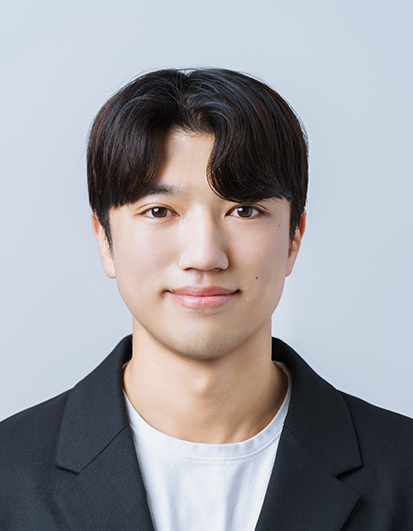
About Me
I am a Ph.D. student in the Department of Statistics and Data Science at Yonsei University, advised by Prof. Kyungwoo Song. I work on large language models (LLMs) and LLM agents from two directions: making LLMs train more stably and run more efficiently, and making LLMs and the agents built on them stay reliable when the data or environment changes.
Research
Efficient LLM architectures and training
- BHyT (ICML 2026, first author). Bounded Hyperbolic Tangent replaces pre-layer normalization in Transformers with a bounded activation. Across pretraining and post-training of 374M to 3B parameter models, it trains 1.6% faster and generates tokens with 1.77% higher throughput than RMSNorm (root mean square layer normalization) on average, while keeping language understanding and reasoning performance. [paper] [code]
- RRD (ICML 2026 Workshop, first author). Routing-and-Residual Distillation converts a dense LLM into a sparse Mixture-of-Experts (MoE) model, where each token activates only part of the feed-forward network (FFN). Converting Qwen2.5-7B into an MoE that turns off 25% of its original FFN per token, RRD raises mean zero-shot accuracy on five benchmarks by 3.1 percentage points over the strongest dense-to-MoE baseline, using only 40M training tokens.
Reliable LLMs and agents under distribution shift
- Causally transportable LLM agents (ongoing). In sequential decision environments with known causal structure, I measure how well the decisions an agent learns from source-domain experience hold up under domain shift. I am designing agents that, at each step, combine causal action effects learned in the source domain with their belief about what has changed in the target domain.
- CCL (NeurIPS 2025, first author). Causal-aware in-context learning learns causal representations that stay invariant across domains and selects demonstrations that share causal features with the query, improving the out-of-distribution (OOD) generalization of in-context learning. [paper] [code]
- Reliable AI contact centers (KDD 2025 Datasets and Benchmarks, first author). A benchmark that evaluates whether foundation models can serve as reliable AI contact centers. [paper]
- CBPE (ACM SAC 2026, first author). Causal-aware blood-pressure estimation that models latent confounders across physiological signals, clinical records, and medical text. [code]
Industry Collaborations
- Upstage AI (2025): developed BHyT and evaluated it across LLM pretraining and post-training.
- Hyundai Motor Group (2025–present): building an on-premise LLM agent on open-source models for vehicle fault diagnosis, covering knowledge extraction from documents, memory construction and retrieval, and automotive safety and quality question-answering datasets.
- Electronics and Telecommunications Research Institute (ETRI) (2024): multimodal blood-pressure estimation that led to CBPE.
See my publications for the full list of papers and my CV for more on my research experience.
Education
- Yonsei University, Korea – Ph.D. in Statistics and Data Science (Mar. 2024 – Feb. 2028, expected)
- University of Seoul, Korea – M.S. in Artificial Intelligence (2022–2024)
- Pukyong National University, Korea – B.S. in Electrical and Semiconductor Engineering (2014–2021)